
Some children walk into a new room and start chatting before their coat is off. Others stay close to Mum or Dad, watch quietly and need a little longer to decide everything is going to be all right.
Neither tells us what a child will eventually achieve. Being quiet isn’t a fault, and we’re not trying to turn every child into the loudest person in the room. We want them to feel comfortable being themselves, confident enough to join in and able to ask for help when they need it.
Parents often ask whether Martial Arts can help a shy child. In our experience at Shin Gi Tai Martial Arts Academy, it can be a very good place to build that confidence, as long as the teaching is patient and the expectations are right for the child.
The first step can be the biggest one
For a nervous child, arriving at an unfamiliar academy is already a challenge. There are new people, new rules and activities they’ve never tried.
Stepping onto the mats may be a bigger achievement for that child than doing the technique perfectly. A good coach notices the courage it takes to join in, not just the finished result.
Tell us if your child is worried before their first class. Knowing what concerns them helps us introduce the class in a way that feels manageable. Sometimes a calm explanation and a friendly introduction make an enormous difference.
Confidence grows more easily when a child feels safe enough to try.
Small moments can change what a child expects of themselves
Over the years, we’ve watched many children become more independent through small, repeated successes.
One of our members, Daniel, needed his dad standing on the mats beside him for his first eight weeks. Some clubs might have seen that as a problem. For us, it was simply how Daniel needed to start. Then, in week nine, he turned to his dad and said, “I can do it.” From that class on, he trained on his own.
Eight years later, Daniel earned his Black Belt. The boy who needed help to join in had become someone who could see a long, demanding challenge through to the end.
Another member, Helen, barely spoke to us, or to her teachers at school, when she started. As she became more comfortable, she gradually found her voice. She went on to win a major role in her school play, join our junior coaching team helping to lead warm-ups and, years later, give a presentation as part of her Master’s degree.
These are individual journeys, not promises of identical results. What they remind us is not to judge a child’s future by how they behave in their first class.
Familiar faces make joining in easier
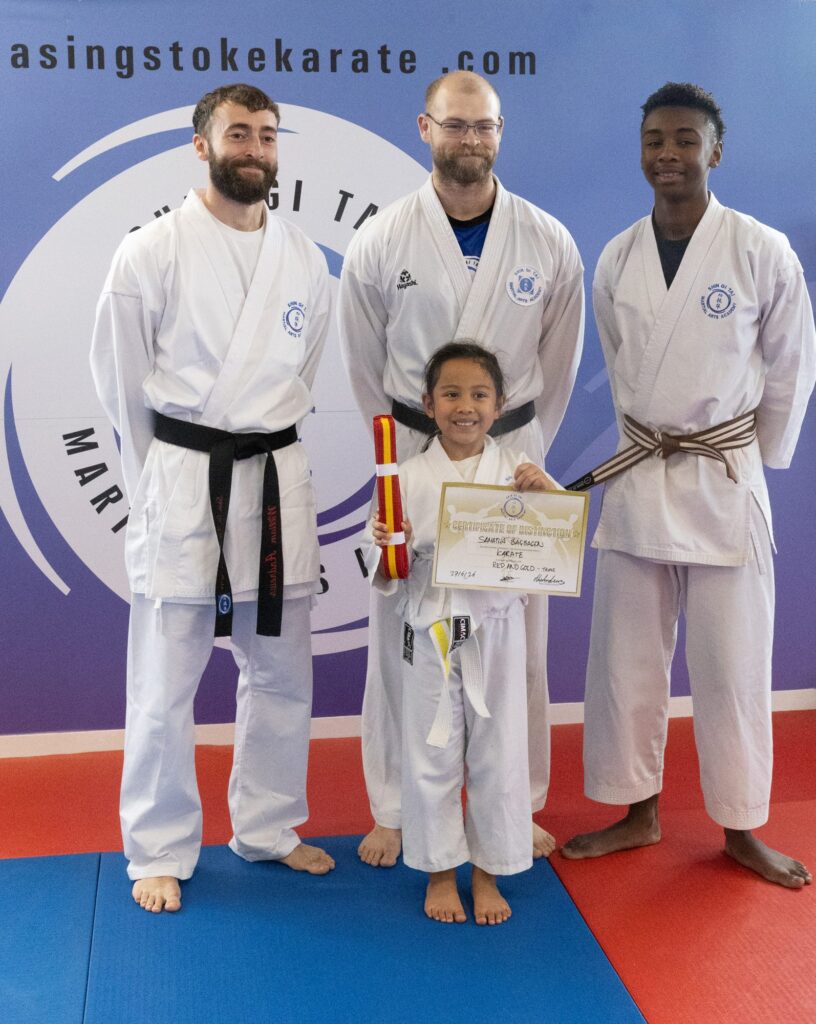
At first, a child may see a room full of strangers. Regular training turns those strangers into familiar classmates and, often, friends.
There’s a shared activity to talk about, a partner to practise with and someone else struggling with the same tricky movement. Children don’t have to invent a conversation from nothing. They already have something in common.
We talk about the class as a community where everyone has a place. Welcoming a newcomer, looking after a partner and noticing another child’s effort are all part of that.
For some children, looking forward to seeing a particular friend is what makes the next visit easier. Belonging grows through those ordinary moments, not through being told to be more sociable.
Confidence comes from doing something difficult
Encouragement matters, but it’s most useful when it helps a child recognise something real.
Perhaps they remembered a sequence, balanced for longer or tried a drill they were worried about last week. The coach can explain what improved and why their effort made the difference.
That gives a child evidence that they can learn. They start to understand that feeling nervous doesn’t mean they can’t do something. “I was nervous, but I managed it” is a thought that carries over into school, friendships and new activities.
It’s also why we don’t expect instant perfection. If every attempt is judged against the best child in the room, a beginner has very little reason to feel successful. We look at progress from each child’s own starting point.
And, between ourselves, plenty of adults feel exactly the same nerves when they start. Children haven’t cornered the market in worrying about looking silly.
Routine makes the unfamiliar more predictable
Clear routines help children settle. Knowing where to stand, how to ask a question and what happens next takes some of the uncertainty out of joining a group.
Our classes combine that routine with activities suited to each stage of development. Younger children need short instructions, manageable tasks and regular encouragement. Older children can take on more detail and responsibility as their confidence grows.
Training alongside children of a similar age helps too. Our Basingstoke children’s Martial Arts classes are grouped as Rising Heroes (ages 4 to 6), Young Legends (6 to 9), Urban Warriors (10 to 13) and Cadets (14 to 17). We can recommend the right class and talk through any support your child may need.
Predictable doesn’t have to mean boring. Children can enjoy plenty of variety while still knowing what’s expected around listening, safety and respect.
Being noticed should feel good
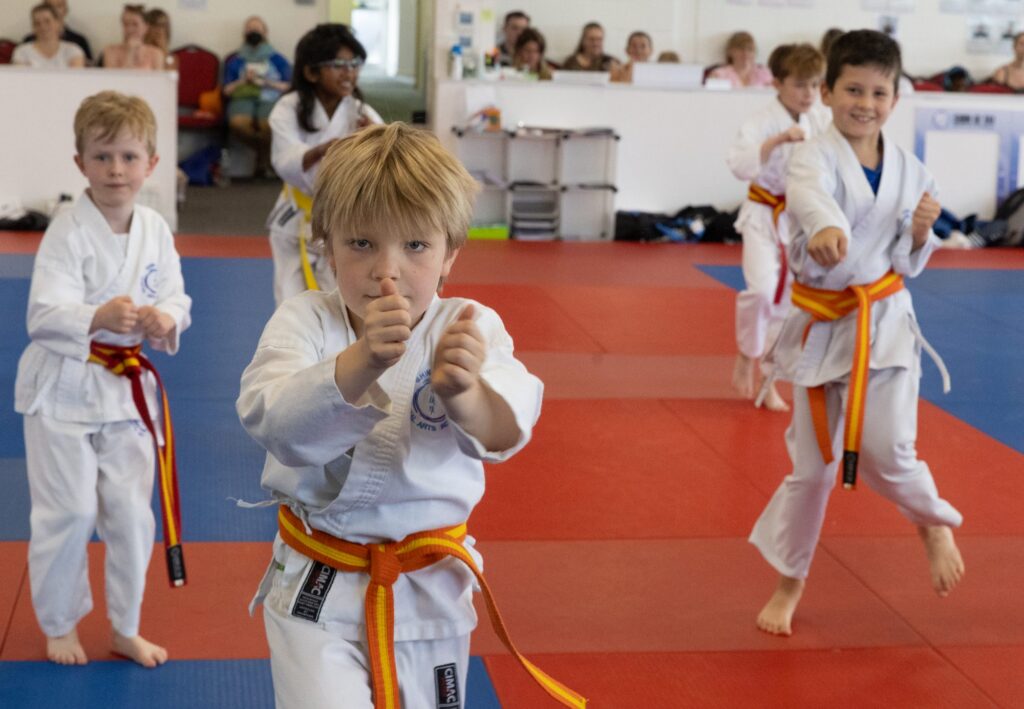
Some children love demonstrating a skill. Others find that kind of attention uncomfortable, especially when they’re new.
A thoughtful coach adapts the way they give recognition. At first, we might count techniques together as a whole class so nobody feels singled out. Later, a quiet word of praise, or “Everyone, look at that kick, that was excellent”, helps a child learn that being noticed goes with achievement rather than embarrassment. We only ask a child to demonstrate when they’re ready.
As their confidence grows, children often become happier answering questions or helping a partner. What matters is that they have support and a reason to feel capable, rather than being put on the spot to prove they’re brave.
The child who quietly joins in today may be the confident assistant helping someone else in a few years. There’s no need to rush.
Parents play an important part
Parents and carers are welcome to watch every class at our Basingstoke academy from our two air-conditioned viewing areas. Knowing you’re nearby can be reassuring in those early weeks.
Children often take their emotional cues from the adults around them, so keep your encouragement calm and specific. You might say, “You listened carefully today,” or, “You tried that even though you were nervous.” Comments like these help a child notice their own progress.
Try not to describe them as shy, or “not very good at that sort of thing”, in front of other people. Children listen closely to what adults say about them, even when they seem busy with something else. Offering too many escape routes, like “You don’t have to do it if you don’t want to”, comes from kindness but can make the next small step harder to take.
It also helps to ask what they enjoyed or would like to practise, rather than making every conversation about how confident they were. If they become upset, talk to the coach and work out a manageable next step together.
The aim is gentle encouragement, with room for your child to tell us how they feel. Our tips on raising a confident child have more ideas for home.
Give confidence time to grow
One of the privileges of coaching for decades is watching children grow into young adults. Some who once needed a lot of reassurance have gone on to earn Black Belts, help coach others and take on real responsibility.
Their personalities don’t all end up the same. A quiet, thoughtful person can be every bit as confident as someone who loves being the centre of attention.
What we hope to build is the belief that they can learn, cope with a challenge and contribute to the group. Regular training, patient coaching and real friendships all help that happen.
If your child is nervous about starting, let us know. We’ll gladly talk through the first visit and help you find the right class at Shin Gi Tai Martial Arts Academy in Basingstoke.