Watch a group of young children learning a new movement and you quickly see that development isn’t a tidy process. One remembers the instructions but loses their balance. Another moves beautifully and forgets what comes next. A third needs a little encouragement before trying at all.
That’s normal. Children are learning to coordinate their bodies, manage their attention and work with other people, all at the same time.
At Shin Gi Tai Martial Arts Academy in Basingstoke, we plan our teaching around those developing skills. Punches, kicks, forms and partner work are all part of the class, but understanding how children learn is what lets us teach them well.
Children aren’t simply smaller adults
A child’s needs change as they grow. The way we explain a movement to a four year old is very different from how we’d discuss it with a teenager.
Younger children benefit from clear demonstrations, short instructions and activities that let them explore movement. Older children can gradually manage longer sequences, more detailed feedback and a deeper understanding of how techniques work.
There are differences within an age group too. Two children with the same birthday may have very different coordination, confidence or physical maturity. Coaches sometimes call this the difference between chronological age (the number of candles on the cake) and biological age (how mature the body and brain actually are). One child might pick up a movement quickly while another needs more repetition.
Good coaching starts by noticing those differences. We want to challenge each child at the right level, rather than treating the fastest learner as the standard everyone else must meet straight away.
Progress doesn’t travel in a straight line
Parents sometimes worry when a child seems to go backwards. A technique they did confidently last month suddenly looks awkward, or they seem less coordinated than before.
Growth can be part of that. As a child’s body changes, they may need time to adjust their balance and movement. Tiredness, school pressures and unfamiliar tasks can also affect what we see in class.
A temporary difficulty doesn’t mean a child has lost interest or stopped trying. The coach needs to think about what has changed and offer the right support.
We look at development over time. There will be quick improvements, quieter spells and skills that take longer than expected. Learning to keep practising through all of that is valuable in itself.
We saw this with one of our girls. When she hit puberty she shot up in a matter of months, and for about six months she didn’t know where her arms and legs were. We nicknamed her “spaghetti arms”, and she described herself as Bambi on ice. She was upset, because she thought she’d suddenly become rubbish at Karate. She hadn’t. Her body had changed faster than her brain could keep up.
So we made her techniques smaller and simpler, almost as if she were a beginner again rather than the black belt she was by then. About a year on, the growth spurt had slowed and she was used to her body again. She came out of it stronger, faster and more capable than before. It just took time, and someone telling her it was normal.
Balance and coordination come before complexity
Before a child can do a controlled kick, they need to manage their balance. Before they can work safely with a partner, they need to understand space, movement and instructions.
These foundations are often called fundamental movement skills. Running, jumping, hopping, turning, throwing and catching all help children develop the confidence and control to enjoy being active.
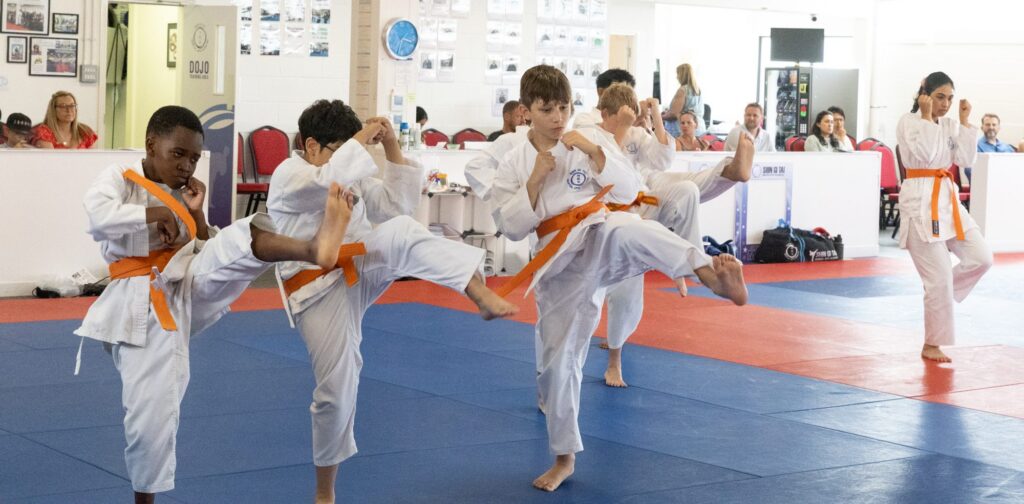
Our Rising Heroes classes for 4 to 6 year olds use games and structured drills to practise these skills. An activity may look playful, but the coach has chosen it for a reason. Changing direction, stopping on a signal or balancing on one leg each gives us something useful to work on.
That foundation helps beyond Martial Arts too. A child who is more comfortable moving has more ways to enjoy PE, swimming, playground games and other sports.
The brain is practising as well as the body
Remembering a sequence, waiting for a signal and changing what you do when a partner moves all take mental effort.
Working memory helps a child remember what comes next. Inhibitory control helps them pause instead of acting straight away. Cognitive flexibility helps them adjust when the task changes. Together, these are part of what researchers call executive function.
In a Martial Arts class, children practise these skills alongside movement. They might listen to a short instruction, show it back, then adapt it during a carefully supervised partner drill.
That doesn’t mean a class guarantees better school results or treats any particular condition. It means the class asks children to use attention, memory and self-control in practical ways, with feedback and plenty of chances to improve.
Remembering a form and remembering to put shoes away are still different challenges. We can’t promise the second will become as exciting as the first.
Variety gives children a broader foundation
Our children’s syllabus combines Karate, Kung Fu and Judo, so children explore different ways of moving at different distances: kicking range, striking range, close-range work and age-appropriate throwing and groundwork.
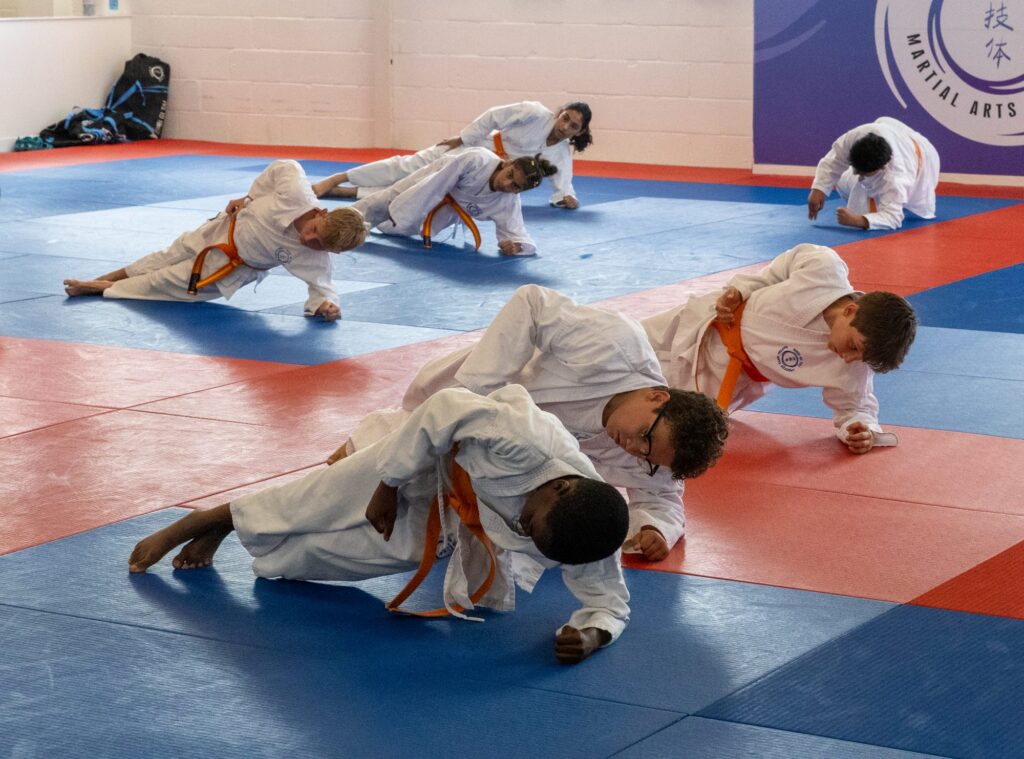
That might mean keeping their balance while kicking, managing footwork for striking, learning to fall safely or practising controlled movement on the floor. The content and level of contact always suit each child’s age and experience.
Variety within classes is useful, but it isn’t the same as playing a range of sports. We also encourage children to enjoy other activities. Swimming, cycling, ball games and outdoor play all offer different experiences and complement their training.
There’s no magic number of practice hours that guarantees expertise. Regular, purposeful practice matters, but so do the quality of teaching, enjoyment, rest and each child’s circumstances.
Making mistakes helps children learn
A child who wobbles during a kick hasn’t failed at Martial Arts. They’ve found something to work on.
Our job is to help them see the next useful step. Perhaps they need to slow down, change their stance or practise a simpler version before adding the rest of the movement.
When that adjustment works, the child connects effort and feedback with improvement. They start to see difficulty as something they can work through, rather than proof they’re no good at it. “I can’t do this” slowly becomes “I can’t do this yet”.
We don’t need to make every task easy. Children benefit from the right level of challenge, with enough support to keep trying. Success means more when they know they earned it.
Every child should be able to take part
Children communicate and learn in different ways. Our coaches adapt instructions, demonstrations and pace so every child has a fair chance to join in. In 2019, our Basingstoke academy became Makaton Friendly, reflecting our commitment to children with communication needs.
If your child has additional needs, please tell us before their first class. We’d much rather plan ahead with you than guess.
Physical development needs sensible support
Training should help a child grow stronger and more capable without copying an adult’s workload. We introduce physical tasks gradually and focus on controlled movement and safe technique.
Conditioning might include balance exercises, crawling, bodyweight movements and carefully supervised partner activities. What we choose depends on the child’s development and the purpose of the exercise.
Parents can support training with ordinary routines: enough rest, water during activity and regular meals through the day. Children need energy for growing as well as exercising. A child’s training should never involve dehydration or pressure to change their body size for sport.
If there’s an injury, ongoing pain or a health concern, let us know and get the right professional advice. A coach should adapt around what they know, not encourage a child to ignore a problem.
Parents should be able to see the teaching
Parents and carers are welcome to watch every class from our two air-conditioned viewing areas. You can see how the class is organised, how the coaches respond to different children and how your child copes with a new task.
Sometimes the most useful achievement isn’t the one that earns a belt. It might be joining in without reassurance, working well with a new partner or trying again after getting something wrong.
Those moments are worth noticing. They help us understand the child as a learner, rather than judging everything by a technical result.
If you have questions about your child’s progress, have a word with the coaching team. Telling us what you see at home or school helps us support them in class.
Professional coaching turns principles into good classes
Our head coach, Bryan Andrews, holds a Master’s degree in Advanced Sports Coaching Practice from Sheffield Hallam University, alongside BJA Level 5, UKCC Level 4 and BCCMA Level 3 coaching qualifications. Our coaching team keeps developing through coach education and experience.
Qualifications matter because they should improve what happens in class. Children need coaches who explain clearly, recognise when an activity needs adapting and understand that confidence and physical skill grow together.
At Shin Gi Tai Martial Arts Academy in Basingstoke, we want children to become capable Martial Artists and enjoy being active for years to come. That starts with teaching the child in front of us, at a pace and level of challenge that helps them learn.